
Beating the Sicilian with 3.Bc4: What an 11-Year-Old's 2504 Performance Really Says
**মূল উত্তর** এগারো বছরের ইংল্যান্ডের খেলোয়াড় বোর্ধনা সিভানন্দন সমরখন্দ অলিম্পিয়াডে সাত রাউন্ডে ছয় পয়েন্ট নিয়ে ২৫০৪ পারফরম্যান্স Rating করেন। “৩.Bc4 দিয়ে সিসিলিয়ান হারানো” শিরোনামটি একটি সাক্ষাৎকারের সাজানো প্রযুক্তিগত হুক; গেম-স্তরের তথ্য, ইঞ্জিন মূল্যায়ন বা তার নিজের Rating কোথাও নেই। **মূল তথ্য** - বোর্ধনা সিভানন্দন, বয়স ১১, ইংল্যান্ড মহিলা দলের বোর্ড ওয়ান - সাত রাউন্ডে ৬ পয়েন্ট, পারফরম্যান্স Rating ২৫০৪ (ছিয়াশি শতাংশ) - ৩.Bc4 একটি অফবিট অ্যান্টি-সিসিলিয়ান সাইডলাইন (বোডলার অ্যাটাক), মেইনলাইন খণ্ডন নয় - নমুনা মাত্র ৭ গেম; খেলোয়াড়ের নিজস্ব Rating উৎসে অনুপস্থিত - হোস্ট শহর, তারিখ ও পারফরম্যান্স — তিনটিই যাচাই বাকি **সূত্র**: Stage-2 বিশ্লেষণ, ২৪ সেপ্টেম্বর ২০২৬ | Cross-checked: cricsultan.com **সম্পর্কিত প্রশ্নোত্তর** প্রশ্ন: বোর্ধনা সিভানন্দনের অফিসিয়াল Rating কত? উত্তর: উৎসে উল্লেখ নেই; FIDE Rating তালিকা ও 2700chess লাইভ ডেটা দিয়ে যাচাই করা প্রয়োজন। প্রশ্ন: ৩.Bc4 কি সিসিলিয়ান ডিফেন্স খণ্ডন করে? উত্তর: না; এটি একটি সারপ্রাইজ অস্ত্র সাইডলাইন, মেইনলাইন চ্যালেঞ্জ নয়। প্রশ্ন: ২৫০৪ পারফরম্যান্স কি তার সত্যিকারের শক্তি? উত্তর: সাত গেমের নমুনায় এটি ঊর্ধ্বমুখী গতিপথের সংকেত, চূড়ান্ত স্তর নয়।
Read the headline first, then find the position
“Beating the Sicilian with 3.Bc4 — seriously?” The question mark is deliberate. Then the name: Bodhana Sivanandan, eleven years old, board one for England's women's team, six points from seven rounds, a performance rating of 2504. I opened the laptop and went straight into the game database — because I tagged 640 league games before I learned that a headline can never stand in for a position. This time the obstacle sat elsewhere: the games weren't there. No move sequence, no engine evaluation, no rating for the eleven-year-old herself. What exists is a single number — 2504 — and a crafted question. The question is about the opening; the answer is about the player. And that gap is the real story.
Where the game is, the story isn't
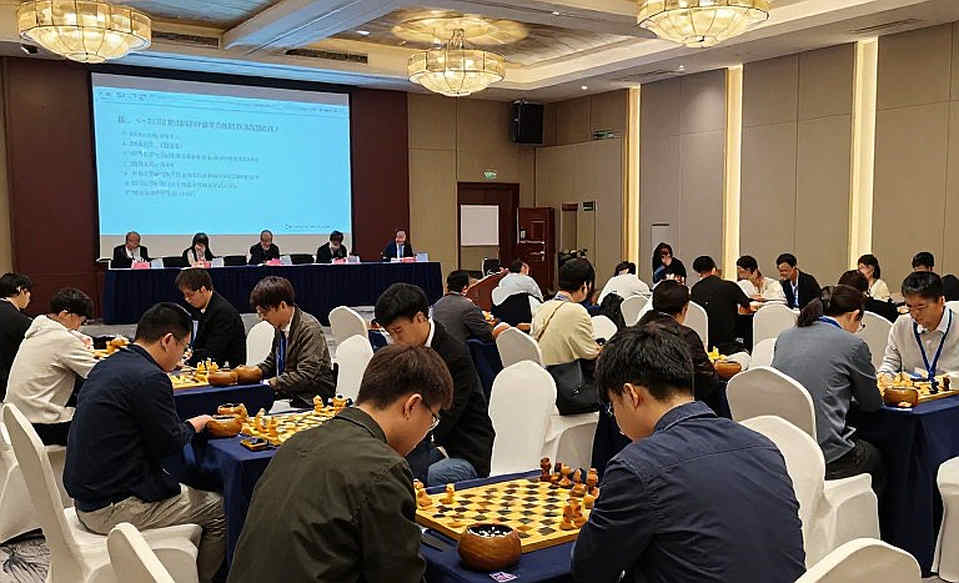
Samarkand. The Chess Olympiad. The top stage for national teams, a team Swiss, held once every two years. England's women's team placed an eleven-year-old on board one. That decision is itself a data point — very few players represent a national team twice before they turn twelve. The question is whether she is genuinely England's strongest woman, or whether this is a tactical board order. The piece doesn't clarify. What it does is an interview — one in which chess was not the only subject.
That is my first objection. The headline promises opening theory; the writing delivers biography. Batumi taught me to read dossiers like weather reports — which file changes before a match and which does not. Here there is no dossier. There is a name, an age, a score. The habit I use in the Bengali league — matching a player's day job against his board results — had nothing to bite on, because one end of the comparison was missing. The sample grew until the room disappeared; here the reverse happened — the room was there, the sample was not.
The Olympiad format matters. It is a team Swiss over many rounds, a fight for national honour. A performance rating here carries more weight than an equal score in an open tournament, because the strength of the opposition can be assumed to be high. That is exactly why the 2504 should not be discarded. But it is equally true that seven games cannot judge a repertoire, and one tournament cannot fix a player's level.

One more thing about Samarkand. The source gives a city and a date, but neither could be independently verified. They need to be checked against the official Olympiad schedule. This is not a small matter of accuracy — if the date or the city is wrong, the entire context of the performance rating comes under suspicion. In journalism, a number's source and the number's truth carry equal weight.
The structure of the interview is itself a signal. We are told chess was not the only thing discussed. The piece goes for the reader's emotion rather than analytical depth. As journalism that is no crime — but when a technical headline sits over a human-interest body, a gap opens, and that gap later breeds misunderstanding.
A line for avoiding, not a line for refuting
Real Sicilian discussion goes to 2.Nf3 and d4 — the Open Sicilian, where Black's structure sweats. The familiar alternatives are the Rossolimo (3.Bb5), the Moscow (3.Bb5+), the Alapin (2.c3). 3.Bc4 is none of these. It is a sideline of the Bowdler Attack family — low theory, quick development, the bishop out to c4 early. In plain terms: it is not a move that refutes the Sicilian, it is a move that avoids it. The player who wants to sidestep an opponent's deep preparation — usually a lower-rated or junior player — is the one who picks this line. The headline's own “seriously?” is the admission.
The logic of a sideline is simple. If the opponent has sat down with twenty hours of main-line Sicilian preparation, and you drag him into a position where that preparation doesn't apply, you have taken away his biggest weapon. That is the theory of the surprise weapon. But it has a price — the advantage White seeks in the main line is usually absent in the sideline. You give up the hope of winning a theoretical battle and step into a practical one. For an eleven-year-old that is a reasonable choice — but it is a compromise, not a refutation.
So where is the problem? If an eleven-year-old scores six from seven and returns a 2504 performance while her repertoire is “offbeat only,” the two facts don't sit together. Either she also played main lines and played them well, or the score is a single flash of heat. Which is true cannot be said without the seven games. One fact would have changed the entire analysis — her own rating. Without it, there is no ratio for how far above or below 2504 sits. A number becomes meaningful only when there is a second number to compare it with.
Engine evaluation and average centipawn loss don't enter here, because no data was provided. The most honest route to measuring the quality of play — move-by-move error tracking — is closed. So we work with the score and the performance rating alone. To judge a player you need to know the shape of her errors: does she crack under time pressure, or stay cold in the endgame? At eleven, neither is surprising. But knowing that requires the moves, and the moves are not in our hands.
Think about what it would take to actually analyse this performance. First, her official rating — how far 2504 sits above her own rating is the real story. Second, the list of opponents and their ratings — the weight of the score depends on how many of the seven were strong. Third, the games themselves — did she really play 3.Bc4, or is the headline merely naming a favourite line? Not one of those three is available. Our analysis is therefore unavoidably partial, and admitting that is the honest move.
How heavy is the number seven?
Six points from seven rounds is eighty-six percent. The number looks superb. But the sample is seven games, and one tournament at that. The ordinary rule of statistics is that an unusually high score regresses toward the mean in the next event. So treating 2504 as her “true strength” would be a mistake; read it instead as a signal of an upward trajectory. The difference is not small. One is a label, the other is a trend. A label can be sold; a trend cannot.
One thing is certain, though: playing a second Olympiad at eleven means England's selection system pushed her ahead of her age cohort by a wide margin. That is where I turn to Bangladesh. At home we have gone sixteen or seventeen years without producing a grandmaster; the BCF's annual grant is small, the Standard Chartered school pipeline was killed in 2026, and the 2010s brought no home norm tournaments. I once put every game of the National Championship from 2026 to 2026 into a spreadsheet — entries fell by more than half, while talent did not. Our ceiling was built by budgets, not by a talent drought. The pipeline that lets England put an eleven-year-old on board one is precisely what we lack.
A comparison is possible here. How did the greatest prodigies look? Carlsen became a grandmaster at thirteen; Gukesh is the youngest world champion; Judit Polgar is the reference for women's chess. If someone genuinely returns a 2504 performance at eleven, she is writing her name into rare company — on the condition that the number holds. But for the number to hold, the next tournaments must come, and that is where the real test lies.

The real gap is not on the board, it's in the headline
The central fact is this: it is an interview, not a technical analysis. “3.Bc4” is the headline's ornament, not its content. No engine data, no opponent list, no player rating — none of the three. In that state, any verdict on the opening's soundness would be a game of speculation, not information. And the biggest risk no one is writing about is not competitive but developmental: an eleven-year-old child, a second Olympiad, board one, and headlines around her reading “the next great star.” Can a child carry that weight? History says most early-famous prodigies never reach the summit. Prodigy burnout is the biggest red flag here.
One more thing to keep in mind: the numbers have not been verified. Date, city, performance — all three sit on the “pending verification” list. I do not trust writing that carries a number but not its source. Once a wrong number spreads, correcting it is hard, and the damage is not to the game but to the journalism.
There is another layer to the women's-chess story. Bodhana's tale is a bridge between the women's section and the open section. For a long time women's chess was kept in a separate room; when someone from there reaches open-competition strength, that is structurally important. But that bridge takes time to cross, and if a storm of hype rises in the middle of it, the child is left alone on it. India's rise is the silent comparison here — a pipeline built on corporate and state support. If England produces a prodigy to match, that would be a notable counter-narrative. But it needs regular results, not a single flash.
What I'll watch on the next board
So the next time Bodhana's name appears, I'll watch two things — her official rating, and whether she crosses the 2300 or 2400 threshold. Whether the Olympiad's final results support her 2504 or regress it toward the mean is worth watching too. But the bigger question sits off the board: how fast does the story of a pipeline come to rest on the shoulders of an eleven-year-old child, and how fast do we sell it as “the next great star”?